
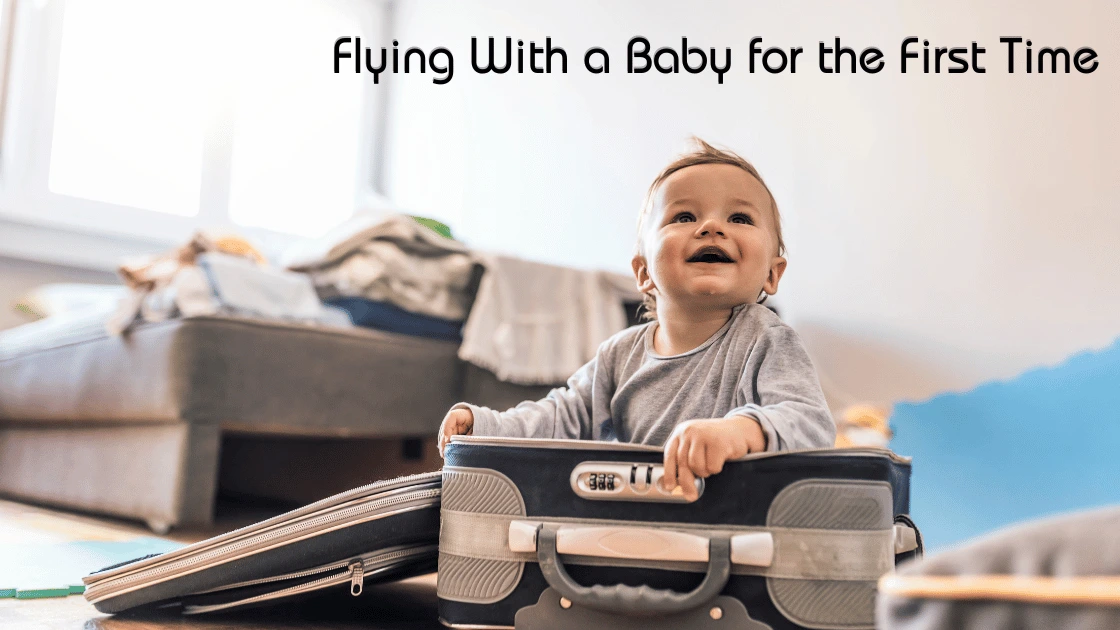
Your first flight with a baby feels completely different from every flight you have taken before.
Before becoming parents, travelling might mean checking your passport, packing a suitcase, reaching the airport and deciding what movie to watch onboard.
With a baby?
Suddenly you’re thinking about diapers, formula, feeding bottles, baby food, stroller rules, baggage allowance, nap timings, ear pressure, immigration, changing diapers onboard and one terrifying question:
What if my baby cries throughout the flight?
The good news is that travelling with a baby is usually far more manageable than first-time parents imagine.
The secret isn’t carrying your entire house with you.
It’s planning the right things before you leave home.
Welcome to Little Traveller, our Travel Addicted series dedicated to helping parents continue exploring the world after having children.
Here’s everything you should know before taking your baby’s first flight.
1. Don’t Be Afraid of Your Baby’s First Flight
Parents often worry about disturbing other passengers.
Try not to make that your biggest concern.
Babies cry.
Sometimes they’re hungry. Sometimes they’re sleepy. Sometimes their ears feel uncomfortable. Sometimes they’re simply overwhelmed by a completely unfamiliar environment.
Your objective isn’t to guarantee a silent flight.
Your objective is to keep your baby safe, comfortable, fed and reasonably rested.
Once you accept that, flying becomes much less stressful.
2. Choose the Flight Carefully
Your baby’s first flight begins before you reach the airport.
It begins while booking the ticket.
When possible, avoid choosing a flight purely because it’s ₹1,000 or ₹2,000 cheaper.
With a baby, timings matter.
Look at:
- Departure time
- Arrival time
- Total journey duration
- Number of connections
- Layover duration
- Airport transfer requirements
- Aircraft type
- Bassinet availability
- Baggage allowance
A nonstop flight may sometimes be worth paying slightly more for.
Every additional connection means another security process, another boarding, another takeoff, another landing and another opportunity for delays.
For your first few journeys with a baby, simple usually beats cheap.
3. Should You Choose a Day Flight or Night Flight?
There isn’t one answer for every baby.
If your baby sleeps reasonably well at night, a flight that overlaps with normal sleep time can work beautifully.
But don’t automatically assume:
Night flight = baby sleeps throughout the journey.
Airports are stimulating environments.
There are lights, announcements, security checks, queues and unfamiliar faces.
Some babies become more active rather than sleepy.
For shorter flights, daytime can sometimes be easier because parents aren’t exhausted themselves.
Observe your baby’s routine and choose accordingly.
4. Check the Airline’s Infant Policy BEFORE Booking
This is extremely important because infant policies vary between airlines.
Check:
- Minimum age for flying
- Infant fare
- Bassinet availability
- Bassinet weight/height restrictions
- Infant baggage allowance
- Stroller allowance
- Car-seat rules
- Baby-food policy
- Priority boarding
- Seat-selection rules
For example, Air India currently defines infants for its travel rules as babies over seven days and under two years and says bassinets are available free subject to availability.
But don’t assume another airline follows exactly the same rules.
Check the airline operating your specific flight.
5. Documents for International Travel With a Baby
One surprisingly common misconception among first-time parents is that a baby doesn’t need the same international documentation because the child is travelling with the parents.
That’s incorrect.
For international travel, your baby needs a passport.
Depending on your destination and nationality, the baby may also require a visa, entry permit or other documentation.
Air India, for example, states that a passport is mandatory for an infant travelling internationally and lists a birth certificate and vaccination certificate among infant documents used for age verification. Its general international-travel guidance also tells passengers to carry applicable visas, entry permits and required health documentation.
Create a dedicated baby travel-document folder containing, as applicable:
- Passport
- Visa
- Flight tickets
- Birth certificate
- Vaccination records
- Travel insurance
- Hotel confirmation
- Return/onward ticket
- Any required consent documentation
Requirements vary by country and circumstances, particularly when a child travels with only one parent or another guardian.
Always verify the destination’s current official requirements before departure.
6. The Diaper Bag Is Your Survival Kit
Your checked suitcase contains things you’ll need at the destination.
Your diaper bag contains things you’ll need when everything goes wrong.
Pack it accordingly.
For a flight, consider carrying:
- Diapers
- Changing mat
- Wet wipes
- Tissues
- Diaper disposal bags
- Two sets of baby clothes
- One spare T-shirt/top for each parent
- Bibs
- Burp cloth
- Feeding bottles
- Formula where applicable
- Baby food where appropriate
- Familiar snacks for older babies
- Pacifier if used
- Small toys
- Muslin/swaddle cloth
- Light blanket
- Essential medicines
- Sanitiser
- Zip-lock/waterproof bags
Why spare clothes for parents?
Because babies don’t restrict spills, spit-up and diaper accidents to their own clothing.
You’ll appreciate that spare T-shirt when there’s still five hours left before reaching the hotel.
7. Don’t Pack Everything at the Bottom
Organisation matters almost as much as what you carry.
Imagine your baby needs a diaper change while you’re standing in an immigration queue.
You don’t want to remove six toys, three bottles and a blanket before finding a diaper.
Use separate pouches.
For example:
Pouch 1 — Diaper change
Diapers + wipes + cream + disposable bag.
Pouch 2 — Feeding
Bottle + formula/food + bib + spoon.
Pouch 3 — Clothes
Baby outfit + parent’s spare T-shirt.
Pouch 4 — Medical
Any essential prescribed/appropriate medicines and health items.
One parent should be able to grab the required pouch in seconds.
8. Baby Food, Formula and Milk at Airports
Rules concerning liquids and baby food can differ by country and airport, so check your departure and transit airport before travelling.
There are often special provisions for infant food.
For example, U.S. TSA rules currently permit formula, breast milk, toddler drinks and baby/toddler food in quantities exceeding the usual 100 ml liquid threshold when travelling through its checkpoints, subject to separate screening procedures.
That is a U.S. rule, not a universal worldwide rule.
Air India separately allows infant food, feeding bottles and an associated carry-on tote within its stated infant cabin allowance.
The practical lesson is simple:
Don’t assume. Check your airline and every relevant airport.
9. Stroller or Baby Carrier?
My answer for most international trips:
Ideally, both — if practical.
A compact stroller is incredibly useful inside large airports and at destinations where you’ll walk for hours.
A baby carrier becomes invaluable when you encounter:
- Stairs
- Cobblestones
- Crowded markets
- Immigration queues
- Boarding stairs
- Places where strollers aren’t allowed
- Uneven paths
Airline stroller policies vary.
Some permit a stroller to be checked at the gate; others have different procedures depending on its dimensions.
For example, Air India currently includes one collapsible stroller, carrycot or infant car seat in its infant checked-baggage provisions.
Confirm the policy for your specific airline before arriving at the airport.
10. Reach the Airport Earlier Than You Used To
If you previously reached the airport at the last possible comfortable moment, baby travel is a good reason to change that habit.
Everything takes longer.
Getting out of the car takes longer.
Check-in takes longer.
Security takes longer.
Feeding takes time.
Diaper changes happen at inconvenient moments.
And babies have an extraordinary ability to require something precisely when boarding begins.
Build buffer time into the journey.
Rushing creates stressed parents.
And stressed parents usually make travelling with a baby harder.
11. Change the Diaper Before Boarding
This tiny habit can make a huge difference.
Try to do a fresh diaper change relatively close to boarding.
Aircraft lavatories are small.
Changing a baby inside one is possible, but nobody would call it luxurious.
Starting the flight with a clean diaper reduces the likelihood that you’ll need to change one immediately after takeoff.
Of course, your baby may have other plans.
That’s travelling with children.
12. What About Ear Pressure During Takeoff and Landing?
This is one of parents’ biggest concerns.
Changes in cabin pressure can cause ear discomfort, particularly during descent.
Swallowing can help equalise middle-ear pressure. The CDC recommends nursing or having an infant suck on a bottle during takeoff and landing; it similarly notes that swallowing helps with pressure-related discomfort.
Depending on your baby’s normal feeding routine, breastfeeding, bottle-feeding or sucking a pacifier may therefore help.
Don’t wake a peacefully sleeping baby solely because somebody on social media said every baby must be fed at one precise moment. If you have concerns about your baby’s ears or health, speak with your paediatrician.
13. Bassinet Seats Can Be Extremely Useful
For longer journeys, ask your airline about bassinets as early as possible.
They’re usually associated with specific bulkhead seating positions and availability is limited.
Air India currently offers bassinets on eligible flights subject to availability and aircraft type.
Don’t wait until boarding to ask.
Contact the airline after booking and verify again closer to departure.
And remember: airline bassinet restrictions differ by aircraft, baby size and airline policy.
14. Don’t Carry Ten Toys
Parents often overpack entertainment.
Your baby may spend fifteen minutes playing with the safety card, bottle cap or your watch while ignoring every carefully selected toy.
Carry a few familiar, lightweight options rather than an entire toy box.
Good choices can include:
- Teether
- Soft toy
- Favourite small toy
- Board book
- Sensory toy
For older babies, introduce one item at a time rather than displaying everything immediately.
Novelty lasts longer that way.
15. Feeding Is More Important Than Following the Clock
Travel days disrupt routines.
That’s normal.
Your baby may become hungry earlier.
Or later.
They may sleep through their usual feeding time.
They may demand another feed because the surroundings are unfamiliar.
For breastfeeding families, the CDC recommends feeding on demand while travelling.
Don’t turn your holiday into a military exercise simply because your home timetable says lunch happens at exactly 1:00 PM.
Maintain familiarity where possible, but allow flexibility.
16. What If the Baby Cries?
First:
Don’t panic.
Second:
Don’t become embarrassed.
Try the obvious possibilities systematically.
Is the baby hungry?
Does the diaper need changing?
Are they too warm or cold?
Are they tired?
Do they need burping?
Are their ears uncomfortable?
Are they overstimulated?
Sometimes walking gently with the baby when permitted can help.
Sometimes feeding helps.
Sometimes a familiar toy works.
And sometimes…
the baby simply cries.
You are not required to apologise to an entire aircraft because your child behaved like a child.
Focus on your baby.
17. Divide Responsibilities Between Parents
Don’t make one parent responsible for everything.
Before entering the airport, decide roles.
For example:
Parent 1: baby + diaper bag.
Parent 2: passports + check-in + cabin baggage.
At security, one handles the baby while the other handles trays and bags.
At immigration, one prepares documents while the other manages the stroller.
During boarding, one gets the cabin organised while the other holds the baby.
This sounds overly organised until you’re simultaneously holding passports, backpacks, a stroller, boarding passes and a hungry infant.
Teamwork changes the entire experience.
18. Consider Priority Boarding Carefully
Families are sometimes offered priority boarding.
Is it always useful?
Not necessarily.
Boarding early gives you time to organise your belongings and settle into the seats.
But it also means your baby spends an additional 20–30 minutes sitting inside an aircraft before departure.
If you’re travelling with another adult, one useful strategy where airline procedures allow it is for one parent to board earlier with the bags while the other keeps the baby outside longer.
Choose whatever creates the least stress for your family.
19. Protect Sleep — But Don’t Chase Perfection
Try to maintain elements of your baby’s normal sleep routine.
Familiar blanket.
Sleepwear.
Feed.
White noise where appropriate.
Dim surroundings.
But accept that the first travel day may be messy.
One unusual nap doesn’t ruin a holiday.
One late bedtime doesn’t destroy a baby’s entire routine.
International travel requires adaptation from adults.
Babies are no different.
20. Keep the First Day at the Destination Light
This is one of the most important Travel Addicted recommendations.
Don’t land after an international flight and immediately schedule six attractions.
Reach the hotel.
Check in.
Feed the baby.
Let everyone rest.
Walk nearby if energy permits.
Have dinner.
Sleep.
Begin serious sightseeing the following morning.
Your first day should be a buffer day, particularly when crossing time zones.
21. Don’t Plan the Same Trip You Would Without a Baby
You can absolutely travel after having children.
But that doesn’t mean travelling exactly the same way.
Perhaps you used to cover five attractions per day.
Make it three.
Perhaps you changed hotels every night.
Stay two or three nights.
Perhaps you left at 7 AM and returned at midnight.
Build a midday break.
The goal isn’t proving that having a baby hasn’t changed your travel style.
It has.
And that’s okay.
You’re not travelling less.
You’re travelling differently.
22. Your Baby May Surprise You
This is the part first-time parents often discover only after actually taking the flight.
Babies can be surprisingly adaptable travellers.
The airport that worried you for weeks might fascinate them.
The flight you thought would be a disaster might become a three-hour nap.
And even when things don’t go perfectly, you’ll learn.
The second flight feels easier.
Then the third.
Soon you’ll have your own systems for bottles, strollers, airport security and diaper bags.
The biggest hurdle is often simply taking that first flight.
Final Thoughts
Travelling with a baby isn’t effortless.
But neither does parenthood mean putting your passport away for the next five years.
Travel slower.
Pack smarter.
Keep realistic expectations.
Prepare for things to go wrong.
And don’t judge the success of a trip by whether every nap and feeding happened according to schedule.
Your baby probably won’t remember their first flight.
You will.
You’ll remember carrying them through the airport.
Their expression when they looked through an aircraft window.
That first passport stamp.
Your first family photograph in another country.
Those are the beginnings of a completely new kind of travel story.
Welcome aboard, Little Traveller.
Frequently Asked Questions
Does a baby need a passport for international travel from India?
Yes. A baby travelling internationally needs their own valid passport. Visa and additional entry requirements depend on the destination.
Can I take a stroller on a flight?
Generally yes, but how it is transported depends on the airline. Check whether your airline permits gate-checking and whether size restrictions apply.
Should I feed my baby during takeoff and landing?
Swallowing can help equalise middle-ear pressure. Nursing or sucking on a bottle can help babies during pressure changes.
Should we book a bassinet?
For a longer flight with an eligible infant, it’s worth requesting one. Availability and restrictions depend on the airline and aircraft.
How early should we reach the airport?
Allow substantially more buffer time than you did before becoming parents, particularly for international flights.
Is travelling internationally with a baby difficult?
It requires more preparation and a slower itinerary, but many of the stressful unknowns become routine after the first few journeys.
LITTLE TRAVELLER RULE #01
Don’t stop travelling. Change how you travel.
Airline, immigration, health and airport-security rules change. Always verify current requirements with your airline, destination authorities and relevant airports before travelling. Medical concerns specific to your child should be discussed with your paediatrician.