
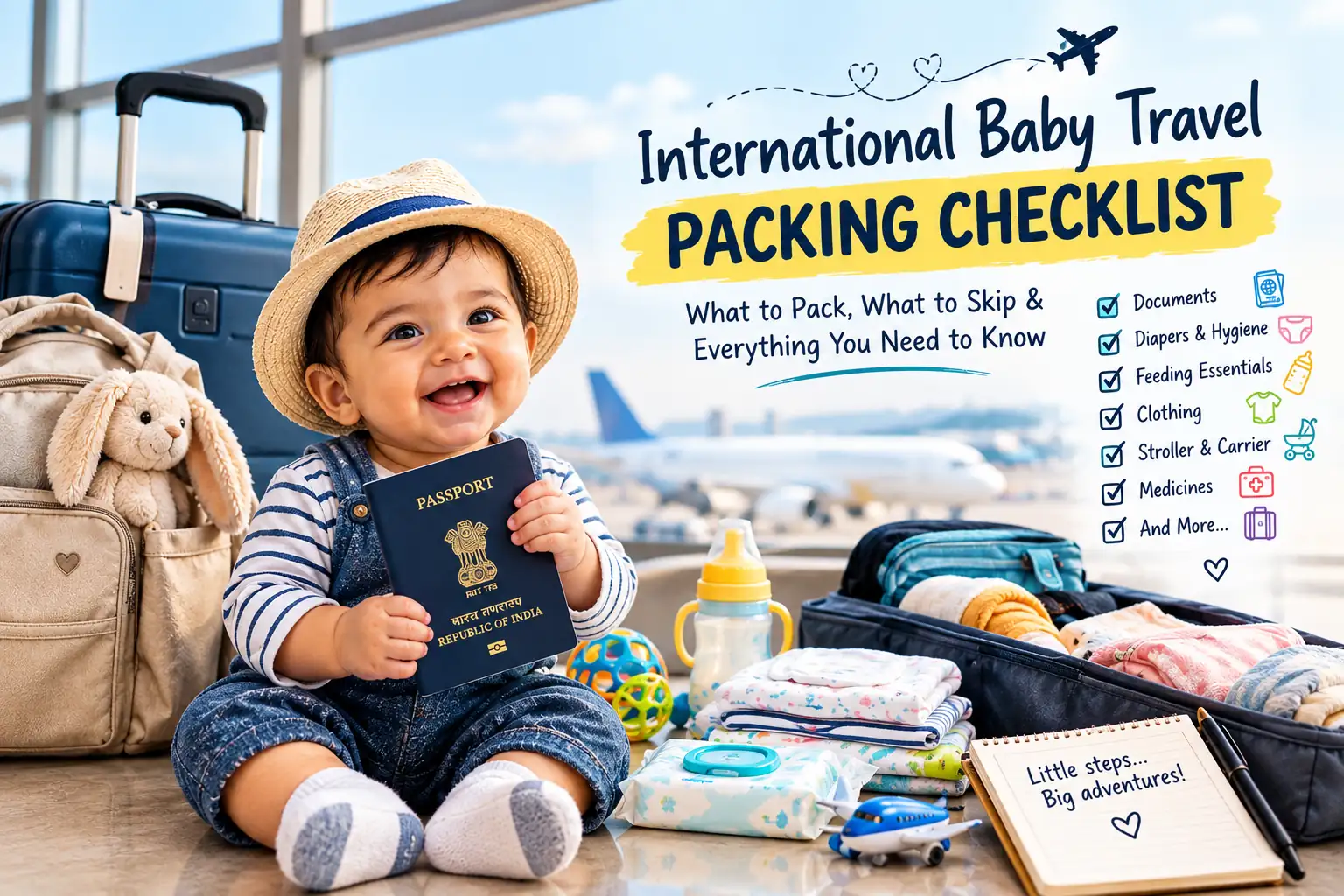
Before travelling with a baby, there’s one question almost every parent asks:
“What if we forget something?”
So we pack everything.
Twenty diapers.
Four blankets.
Three toys the baby has never played with.
Enough clothes for a small nursery.
Six feeding bottles.
A giant stroller.
Medicines.
Food.
Sterilising equipment.
And somewhere underneath all of that…
our own clothes.
Travelling with a baby does require more planning.
But it doesn’t require carrying your entire house.
The secret is dividing everything into three categories:
What must stay with you.
What can go into checked baggage.
What you can easily buy at the destination.
This is the Travel Addicted international baby-packing system.
First: Your Baby Needs Their Own Passport
This sounds obvious until somebody asks whether a baby can travel internationally on a parent’s passport.
For Indian travellers, the answer is no.
Indian minor children require separate passports. Passport Seva states that children are not included in their parents’ passports; minors below 15 are generally issued a passport valid for five years or until age 18, whichever is earlier.
So your first packing item isn’t a diaper.
It’s:
Baby’s passport.
Then verify the destination’s visa/entry rules specifically for the infant.
A baby isn’t automatically covered because the parents have visas.
BAG 1 — THE DOCUMENT POUCH
This never goes into checked baggage.
Keep it with one parent at all times.
Carry:
Baby passport.
Parents’ passports.
Visa/entry documentation.
Flight tickets.
Hotel confirmations.
Travel insurance documents.
Birth certificate copy.
Vaccination/health documents where relevant.
Any consent documentation relevant to your family/travel circumstances.
Prescription copies.
Emergency contacts.
Digital backups stored securely online are useful, but I still like keeping important physical copies.
When travelling with a baby, your phone battery should not be the only thing standing between you and an important document.
BAG 2 — THE DIAPER BAG
This is the most important bag in the entire trip.
Not your suitcase.
Not your camera bag.
The diaper bag.
It needs to survive:
Airport.
Security.
Flight delay.
Boarding.
Flight.
Immigration queue.
Baggage delay.
Transfer.
And potentially several hours before you reach the hotel.
So don’t pack it according to the scheduled flight time.
Pack it according to:
Scheduled journey + sensible delay buffer.
How Many Diapers?
Don’t count only the flight hours.
Count from leaving home until reaching the hotel.
Then add a buffer.
For example:
Home → airport: 1 hour
Airport formalities: 3 hours
Flight: 5 hours
Immigration/baggage: 1 hour
Airport → hotel: 1 hour
Your five-hour flight has actually become an 11-hour travel day.
Pack accordingly.
Then add extras.
Diapers are light.
Running out of them at 35,000 ft isn’t fun.
Diaper-Changing Kit
Keep one small pouch containing:
Diapers.
Baby wipes.
Changing mat.
Diaper-rash cream.
Disposable bags.
Tissues.
Hand sanitiser for adults.
Spare baby clothes.
One spare top for each parent.
That last item is important.
Parents pack four outfits for the baby and forget that babies have an impressive ability to ruin your clothes too.
The One-Diaper-Pouch Trick
Instead of carrying a giant diaper bag into the aircraft lavatory, create a small grab-and-go changing pouch.
Put inside:
1–2 diapers.
Small wipes pack.
Changing mat.
Disposable bag.
Cream.
Spare onesie.
When it’s time for a change:
Grab one pouch.
Go.
This tiny organisational trick makes aircraft diaper changes much easier.
BAG 3 — FEEDING
This depends completely on your baby’s age and feeding routine.
You might need:
Breastfeeding cover if preferred.
Formula.
Feeding bottles.
Sterilised/clean bottles.
Bottle brush.
Portable drying solution.
Baby spoon.
Bib.
Burp cloth.
Baby cereal.
Prepared solids where suitable.
Snacks for older babies.
Sippy/straw cup.
Water as appropriate for the child’s age and destination.
And enough feeding supplies to handle delays.
Can Baby Milk and Food Go Through Airport Security?
Rules vary by country and airport, so always verify your departure, transit and destination requirements.
But infant feeding items often receive specific allowances.
For example, Air India’s current guidance permits baby food/products including milk, juice, sterilised water and meals in liquid, gel or paste form in quantities considered sufficient for the journey.
That doesn’t mean every airport worldwide applies identical procedures.
Keep baby food organised and easily accessible.
At security, tell staff what you’re carrying rather than burying it underneath twenty other items.
Formula Feeding While Travelling
If using formula, simplicity matters.
Pre-measure portions where appropriate.
Keep clean bottles organised separately from used ones.
Understand how you’ll obtain safe water during the journey.
Don’t create an elaborate feeding system that requires ten pieces of equipment every three hours.
The best travel system is the one you can operate while tired, standing in an airport and holding a baby.
BAG 4 — BABY FOOD
Once your baby is eating solids, don’t assume you’ll find exactly the same food everywhere.
For the travel day, carry familiar food the baby already tolerates.
Depending on age and routine, this might include suitable items such as:
Baby cereal.
Fruit preparations.
Soft foods.
Age-appropriate snacks.
Or other familiar meals.
Don’t make the airport the place where you experiment with an entirely new food.
Familiarity is your friend on travel days.
BAG 5 — CLOTHING
Here’s where parents massively overpack.
A practical system is:
Daily outfits + sensible extras
rather than
Every cute outfit the baby owns.
Pack according to climate.
Include:
Onesies/body suits.
T-shirts/tops.
Bottoms.
Nightwear.
Socks.
Warm layer.
Sun hat or warm cap depending on destination.
Swimwear if relevant.
Light blanket.
And a few emergency outfit changes.
Then ask:
Can I wash clothes during the trip?
If you’re staying seven nights in apartments or hotels with laundry access, you don’t need fourteen complete outfits.
Use Packing Cubes
This is one of my favourite family-travel systems.
Cube 1 — Baby daily clothes
Cube 2 — Nightwear
Cube 3 — Cold/weather layers
Cube 4 — Feeding
Cube 5 — Diapers/hygiene
Cube 6 — Parents
When you’re tired, you don’t want to unpack an entire suitcase searching for one pair of baby socks.
Organisation saves more stress than carrying more stuff.
STROLLER OR BABY CARRIER?
My answer?
For many international trips:
Both — if practical.
They solve different problems.
Stroller
Great for:
Airports.
Malls.
Long city walks.
Flat attractions.
Nap time.
Carrying small items.
Baby Carrier
Better for:
Stairs.
Crowded markets.
Historic areas.
Uneven streets.
Temples.
Boarding aircraft.
Places where strollers become more trouble than help.
A lightweight folding stroller plus comfortable baby carrier is an extremely versatile combination.
Check Your Airline’s Stroller Rules
Don’t assume every airline handles strollers identically.
For example, Air India currently allows one collapsible stroller, carrycot or infant car seat per infant as part of its infant provisions.
Other airlines may have different weight, size, gate-check or baggage rules.
Check before departure.
And if your stroller is expensive, consider a protective travel bag.
Baggage handling isn’t a stroller beauty treatment.
BASSINET — DON’T ASSUME YOU HAVE ONE
Long flight?
Check whether your aircraft and airline offer bassinets.
Then request one early.
Air India, for example, currently offers infant bassinets free of charge but subject to availability.
The important phrase is:
subject to availability.
A bassinet request isn’t the same thing as a guaranteed bassinet unless the airline confirms it under its own policy.
Plan for what you’ll do if one isn’t available.
BABY MEDICINE KIT
This is one area where I wouldn’t copy a random internet packing list.
Discuss appropriate medicines and doses with your child’s paediatrician based on:
Age.
Weight.
Destination.
Trip duration.
Medical history.
Your kit might include prescribed or recommended medicines plus:
Thermometer.
Nasal care items if used.
Bandages/basic first aid.
Any regular medicines.
Prescription copies.
But don’t give medication merely because a travel blogger listed it.
Your baby’s doctor knows your baby.
The internet doesn’t.
BATH & HYGIENE KIT
Keep this small.
Travel-size baby wash.
Baby moisturiser.
Diaper cream.
Toothbrush if age appropriate.
Comb.
Nail care only if genuinely needed.
Small towel if your accommodation won’t provide something suitable.
Laundry detergent/sheets if you plan to wash baby clothes.
You don’t need to recreate the baby’s bathroom shelf inside your suitcase.
SLEEP KIT
Sleep is one of the biggest concerns when travelling with babies.
Carry familiar sleep cues where practical:
Sleep sack.
Small familiar blanket if age-appropriate and used safely.
White-noise machine or phone solution.
Pacifier if used.
Favourite small comfort item where developmentally appropriate.
Maintain some familiar routine even if the timezone changes.
Bath.
Milk.
Dim lights.
Sleep.
The hotel room is different.
The routine doesn’t have to be completely different.
DON’T FORGET THE HOTEL
Before carrying half your nursery internationally, email the hotel.
Ask whether they provide:
Baby cot.
High chair.
Kettle.
Microwave access.
Mini-fridge.
Bottle steriliser.
Baby bathtub.
Laundry.
Connecting rooms.
If the hotel provides something reliably, don’t carry your own unless you specifically need it.
Packing smarter begins before packing.
What Goes in Checked Baggage?
Generally, keep non-urgent bulk items here:
Most baby clothing.
Bulk diapers.
Extra wipes.
Backup formula/food where permitted.
Toiletries.
Extra bedding.
Swim items.
Larger toys.
Bottle-cleaning equipment.
Anything you won’t desperately need during a baggage delay.
But never check in every diaper, every feeding item and every change of clothes.
If your suitcase goes to Singapore while you go to Bangkok, you still need to survive the night.
What Goes in Cabin Baggage?
The rule is simple:
Everything needed to keep the baby fed, clean, comfortable and reasonably settled until you reach your accommodation.
That means:
Documents.
Diapers.
Wipes.
Changing supplies.
Food/milk.
Bottles.
Medicines.
Spare baby clothes.
Parent’s spare top.
Small toys.
Pacifier.
Light blanket.
Phone charger/power bank where permitted.
And any essential item you cannot easily replace.
Air India currently allows infant cabin items including food for the flight, feeding bottles and a carry-on tote, subject to its size/weight conditions.
Always check your actual operating airline.
The Toy Rule
Don’t carry a toy shop.
For a baby, consider:
One familiar favourite.
One teether.
One quiet new object/toy.
One book.
Maybe one sensory item.
Then improvise.
A baby may spend twenty minutes fascinated by:
The safety card.
A paper cup.
The window shade.
Your watch.
The seatbelt buckle.
Meanwhile, the ₹1,500 travel toy you carefully researched remains untouched.
Welcome to parenting.
Pack for the Destination, Not Instagram
Going to Singapore?
Prepare for heat, humidity and air-conditioning.
Going to Switzerland?
Layers.
Going to a beach destination?
Sun protection and swim items.
Going somewhere with poor supermarket access?
Carry more essentials.
Going to a city with pharmacies and supermarkets everywhere?
Carry less.
The perfect baby packing list doesn’t exist independently of the destination.
Our 5-Bag System
Here’s the simplest way to remember everything.
1. DOCUMENT BAG
Passports, visas, insurance, bookings.
2. DIAPER BAG
Diapers, wipes, clothes, changing.
3. FEEDING BAG
Milk, food, bottles, bibs.
4. BABY TRAVEL GEAR
Stroller, carrier, car seat where needed.
5. CHECKED SUITCASE
Clothes, bulk supplies and non-urgent equipment.
That’s it.
Stop thinking in terms of 150 individual objects.
Think in systems.
24 Hours Before Departure
Don’t start packing from scratch.
Use this final checklist:
Documents checked.
Airline infant policy checked.
Baggage allowance checked.
Stroller policy checked.
Bassinet status checked.
Baby food prepared.
Bottles organised.
Medicines packed.
Diaper bag replenished.
Hotel transfer confirmed.
Baby cot confirmed where required.
Weather checked.
Offline copies/screenshots saved.
Phone charged.
Power bank charged.
And one more thing:
Parents sleep.
At least try.
Frequently Asked Questions
Does an Indian baby need a passport for international travel?
Yes. Indian minors require their own passport.
Can I carry baby milk through airport security?
Infant-food rules vary by jurisdiction. Air India currently permits necessary baby food, milk, juice and sterilised water for the journey under its stated conditions. Always verify the airports and airline involved.
Can I take a stroller on an international flight?
Usually yes in some form, but airline rules differ. Air India currently includes one collapsible stroller, carrycot or infant car seat in its infant provisions.
Does a bassinet cost extra?
It depends on the airline. Air India’s current policy says bassinets are free but subject to availability.
What documents should I carry for my baby?
At minimum, check passport and destination visa/entry requirements. Depending on your circumstances, also consider birth, vaccination, consent and other supporting documentation. Air India currently lists passport as mandatory for international infant travel and may require age-related documents at check-in.
Should I carry diapers for the entire holiday?
Not necessarily. Research whether your preferred type/size is easily available at the destination. Carry enough for travel plus an initial buffer, then buy locally when practical.
Final Thoughts
The goal isn’t packing everything your baby could possibly need.
It’s packing everything that would be difficult to manage without.
There’s a difference.
The first time you travel internationally with a baby, your suitcase may look like you’re relocating permanently.
By the third trip?
You start understanding what actually gets used.
The giant sterilising machine stays home.
The tenth toy stays home.
Half the clothes stay home.
And the one thing you forgot on the first trip?
That goes straight into the diaper bag.
That’s how family travel works.
You don’t need to become perfectly prepared before travelling with your baby.
You become better at travelling with your baby…
by travelling.