
There are places that look beautiful.
And then there are places that make you wonder whether you’re still on Earth.
Socotra is one of them.
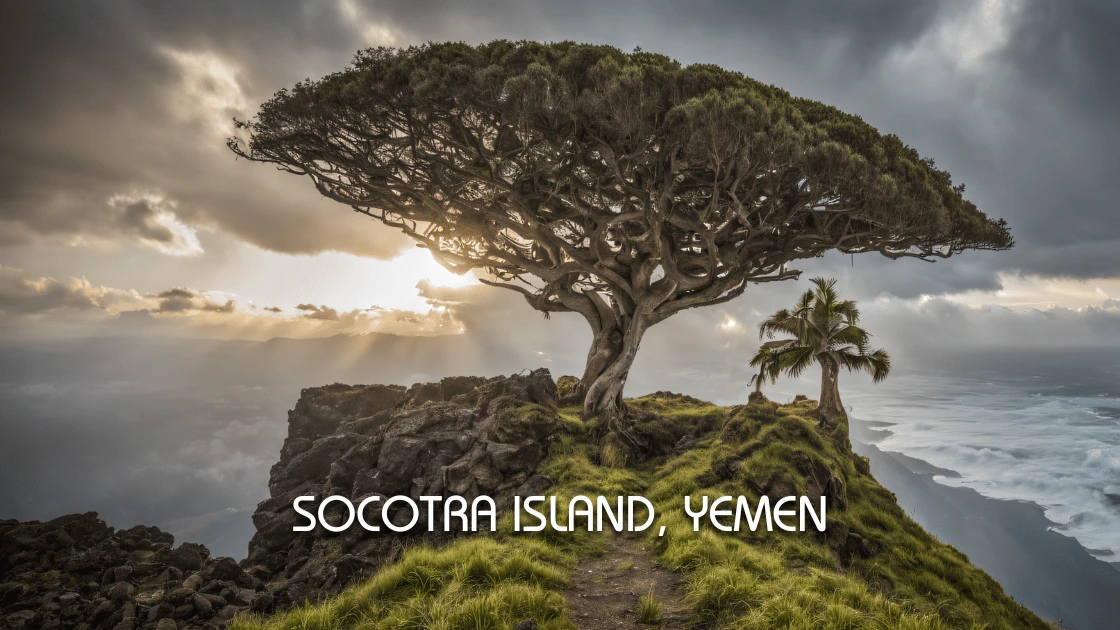
Imagine an island where umbrella-shaped trees rise from barren mountains.
Where enormous bottle-shaped desert roses grow directly from rock.
Where white sand dunes tumble towards turquoise water.
Where caves disappear deep beneath limestone mountains.
And where species exist that you won’t naturally find anywhere else on Earth.
Welcome to Socotra.
Part of Yemen and sitting in the northwestern Indian Ocean near the Gulf of Aden, the Socotra Archipelago is one of the planet’s most unusual ecosystems.
UNESCO says 37% of its plant species, 90% of its reptile species and 95% of its land-snail species occur nowhere else on Earth. The archipelago became a UNESCO World Heritage Site in 2008.
It’s easy to understand why Socotra is sometimes compared with the Galápagos.
But there’s something important we need to discuss before turning this into another bucket-list article.
Should You Travel to Socotra Right Now?
As of October 2026, this is not a destination Travel Addicted should casually recommend booking.
Socotra belongs to Yemen. Current UK government advice warns against all travel to Yemen, and current U.S. guidance explicitly says not to travel to Socotra or any other part of Yemen. The U.S. advisory also warns that some tour operators have misrepresented safety and offered unofficial or invalid visas.
UNESCO’s 2026 World Heritage decision also notes continuing political instability, conflict, economic pressure and growing environmental threats affecting the archipelago.
So this guide is different.
Think of it as:
A journey into one of Earth’s most extraordinary places — and a destination to understand, follow and perhaps visit when circumstances allow responsible travel.
Why Does Socotra Look Like Another Planet?
Isolation.
For millions of years, Socotra’s geographic isolation allowed plants and animals to evolve independently.
The result is extraordinary endemism.
The island doesn’t simply have unusual scenery.
It has an ecosystem that exists almost nowhere else.
The most famous example is impossible to miss.
The Dragon’s Blood Tree
This is Socotra’s icon.
Its trunk rises before exploding outward into an enormous umbrella-shaped canopy.
From a distance, groups of these trees look almost computer-generated.
But they’re real.
Dracaena cinnabari, the Socotra dragon’s blood tree, gets its dramatic name from the deep red resin historically produced from the tree.
UNESCO describes it as one of the archipelago’s emblematic endemic species.
And sadly, it’s also vulnerable.
Climate change, grazing pressure, development and ecosystem changes threaten Socotra’s extraordinary biodiversity.
That makes travelling responsibly here especially important if tourism conditions improve.
1. Diksam Plateau — Land of the Dragon’s Blood Trees
If there’s one landscape that represents Socotra, it’s the highlands filled with dragon’s blood trees.
The Diksam Plateau is where the island starts looking genuinely extraterrestrial.
Rocky mountains.
Deep valleys.
Sparse vegetation.
And hundreds of bizarre umbrella-shaped trees scattered across the landscape.
This isn’t the kind of place where I’d rush through twenty photo stops.
Walk.
Observe.
Spend time beneath the trees.
Look at their structure.
Then look at the entire forest from a distance.
The individual tree is extraordinary.
But an entire landscape filled with them is what makes Socotra unforgettable.
2. Firmihin Forest
Want even more dragon’s blood trees?
The Firmihin area contains one of Socotra’s important concentrations of them.
For photographers, this would be one of the places I’d prioritise around sunrise or sunset.
As the light changes, the trees become silhouettes against the mountains.
This is also where tourism needs restraint.
These aren’t props.
They’re part of a fragile ecosystem.
Don’t climb trees.
Don’t damage roots.
Don’t collect resin or plant material.
And don’t leave a single piece of rubbish behind.
3. Detwah Lagoon
Then Socotra changes completely.
From strange mountain forests…
to turquoise water.
Detwah Lagoon is one of the archipelago’s spectacular coastal landscapes and is internationally recognised as a Ramsar wetland site. UNESCO notes Socotra’s Ramsar designation alongside its Biosphere Reserve and World Heritage status.
White sand.
Blue-green water.
Mountains.
Marine life.
And enormous open landscapes.
This is the kind of place where doing almost nothing becomes the activity.
Walk.
Swim only where local conditions and guidance indicate it’s safe.
Watch birds.
Photograph sunset.
And enjoy the fact that you’re somewhere that still feels genuinely remote.
4. Qalansiyah
Near Detwah lies Qalansiyah, one of Socotra’s principal settlements.
For travellers, places like this are important because Socotra shouldn’t become a story only about strange trees.
People live here.
Socotra has its own cultural heritage and its own endangered Soqotri language, which UNESCO specifically highlights as part of the archipelago’s identity.
Responsible tourism needs to recognise the island as someone’s home rather than an empty wilderness created for adventure travellers.
5. Shoab Beach
From Qalansiyah, the coast leads towards remote beaches including Shoab.
Imagine approaching by boat.
Bare mountains behind you.
Almost-white sand ahead.
Turquoise Arabian Sea.
Possibly dolphins offshore.
No beach clubs.
No giant resort.
No rows of umbrellas.
Just coastline.
This is the opposite of mass-market island tourism.
And hopefully, if tourism grows in the future, Socotra doesn’t lose exactly what makes it special.
6. Arher Beach — Where the Desert Meets the Sea
Now imagine an enormous white sand dune pressed against a mountain.
At its base?
The Arabian Sea.
That’s the visual appeal of Arher.
This is one of those places where a photograph struggles to communicate scale.
The dunes are huge.
The mountains are huge.
And the people standing beneath them look tiny.
If you’re physically fit and conditions are suitable, climbing part of the dune for sunrise or sunset can create extraordinary views.
But remember:
Sand climbing looks much easier from below.
Every step upward slides partially backwards.
7. Hoq Cave
Socotra isn’t only spectacular above ground.
Its limestone landscape contains extensive caves.
Hoq Cave is among the best known.
Reaching it requires a hike, and inside you’ll encounter stalactites, stalagmites and enormous underground chambers.
A good local guide isn’t simply useful here.
It’s essential.
Remote cave environments are not places to improvise your own route.
Carry reliable lighting.
Wear suitable footwear.
And don’t touch formations unnecessarily.
A stalactite that took thousands of years to develop doesn’t need your fingerprint.
8. Homhil Protected Area
Homhil combines several of Socotra’s signatures:
Dragon’s blood trees.
Frankincense trees.
Mountains.
Rock formations.
And natural pools.
The elevated landscapes also provide spectacular views towards the coastline.
It’s one of those destinations that makes Socotra feel like several countries compressed onto one island.
Morning: mountains.
Afternoon: desert.
Evening: beach.
And none of it looks ordinary.
9. Socotra’s Bottle Trees
Dragon’s blood trees get most of the attention.
But don’t overlook the Socotra desert rose.
Its swollen trunk looks like someone planted a giant vase directly into a rock.
These unusual forms are adaptations to Socotra’s harsh, dry environment.
UNESCO specifically highlights plants such as the desert rose, cucumber tree, Socotra fig, dragon’s blood tree and frankincense species as examples of the island’s unusual flora.
If you’re interested in nature photography, Socotra isn’t simply one destination.
It’s an endless subject.
10. The Marine World
The biodiversity doesn’t stop at the shoreline.
UNESCO records 253 species of reef-building coral and 730 species of coastal fish in the archipelago’s marine environment.
That means Socotra has enormous potential for diving, snorkelling and marine exploration.
But marine tourism needs exactly the same restraint as land tourism.
Don’t stand on coral.
Don’t collect shells from protected ecosystems.
Don’t chase wildlife.
And don’t treat the ocean like an underwater souvenir shop.
What Would a Socotra Itinerary Look Like?
If safe, lawful and responsible tourism conditions eventually allow the journey, I wouldn’t attempt Socotra in three or four days.
A conceptual 7-day nature itinerary could look like:
Day 1 — Arrival + Hadibo orientation
Day 2 — Diksam Plateau + Firmihin
Day 3 — Qalansiyah + Detwah Lagoon
Day 4 — Shoab coast
Day 5 — Arher + eastern coast
Day 6 — Hoq Cave + Homhil
Day 7 — Buffer / nature exploration / departure
But unlike our Meghalaya or Albania itineraries, don’t treat this as a currently recommended self-booking route.
Current security conditions, legitimate entry procedures, flights, insurance and local access need fresh verification before any future trip.
Socotra Is Not a Luxury Holiday
If your definition of travel requires:
Five-star resorts.
Perfect Wi-Fi.
Room service.
Shopping malls.
Predictable transport.
And international-standard tourist infrastructure…
Socotra isn’t the destination you’re looking for.
Its attraction is almost the opposite.
Remote landscapes.
Camping-style travel.
Simple facilities.
Nature.
Isolation.
And unpredictability.
The discomfort is part of the experience.
Responsible Tourism Matters More Here
Socotra is fragile.
UNESCO’s 2026 assessment says the site’s biodiversity remains exceptional, but terrestrial and marine ecosystems face threats including development pressure, pollution, invasive species, climate change and unsustainable resource use.
That means tourism shouldn’t become another pressure.
If responsible travel becomes feasible:
Use legitimate local operators.
Follow protected-area rules.
Avoid single-use plastic wherever practical.
Don’t collect plants, shells or wildlife.
Use water carefully.
Respect communities.
Don’t drive off established tracks unnecessarily.
Don’t disturb nesting birds.
And support local people rather than creating an imported tourism bubble.
Frequently Asked Questions
Where is Socotra?
Socotra is a Yemeni archipelago in the northwestern Indian Ocean near the Horn of Africa.
Why is Socotra famous?
Its extreme biodiversity and unusual endemic plants—especially the dragon’s blood tree—make it one of Earth’s most distinctive natural environments.
Is Socotra a UNESCO World Heritage Site?
Yes. The Socotra Archipelago was inscribed in 2008 for its exceptional biodiversity.
Is Socotra safe to visit right now?
Current UK guidance advises against all travel to Yemen, while U.S. guidance explicitly includes Socotra in its do-not-travel advice. Anyone considering a future trip should check current Indian government advice, legitimate Yemeni entry requirements, insurance and transport conditions immediately before making a decision.
Can you travel independently?
This isn’t a destination where I’d recommend improvising an independent trip. Entry, transport, protected areas and security conditions require current specialist/local guidance.
What makes Socotra biologically unusual?
UNESCO reports that 37% of its plant species, 90% of reptile species and 95% of land-snail species occur nowhere else.
Final Thoughts
Socotra challenges what we think Earth should look like.
A tree shaped like an umbrella.
A plant shaped like a bottle.
A desert falling directly into turquoise water.
An isolated language.
Species found nowhere else.
It feels fictional.
But perhaps the most important reason to talk about Socotra isn’t to immediately put it on a booking list.
It’s to understand that places like this still exist.
And that if we eventually get the privilege of visiting them…
our responsibility isn’t simply to photograph them.
It’s to help ensure they’re still extraordinary for the traveller who arrives fifty years after us.