
Imagine waking up to clouds floating through green valleys.
Driving past waterfalls that appear beside the highway.
Walking across bridges that aren’t built from concrete or steel, but are alive and still growing.
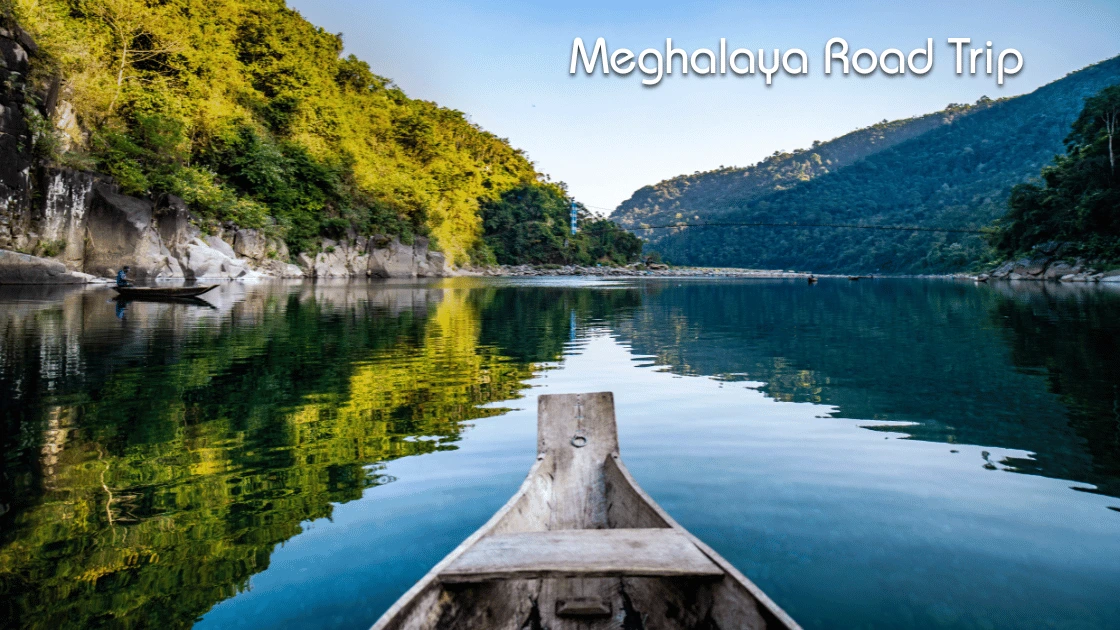
Boating over a river so clear that your boat appears to be floating in the air.
Descending thousands of steps through a rainforest to discover a double-decker living root bridge.
And ending the day in a small mountain village surrounded by silence.
Welcome to Meghalaya — the Abode of Clouds.
For travellers who love road trips, waterfalls, trekking, forests, villages, caves and landscapes, Meghalaya is one of India’s most exciting destinations.
But there’s one mistake many first-time visitors make.
They try to see Meghalaya too quickly.
Shillong, Cherrapunji, Dawki and Mawlynnong might look close together on a map, but Meghalaya isn’t a destination where you should calculate your itinerary only in kilometres.
Mountain roads, viewpoints, waterfalls, weather and spontaneous stops are all part of the journey.
So instead of rushing through Meghalaya in three or four days, here’s how we’d plan a 7-day Meghalaya road trip.
Meghalaya 7-Day Road Trip at a Glance
Day 1
Guwahati → Umiam Lake → Shillong
Day 2
Shillong → Laitlum Canyon → Local Shillong
Day 3
Shillong → Mawkdok → Sohra/Cherrapunji
Day 4
Nongriat Double-Decker Living Root Bridge Trek
Day 5
Sohra → Mawlynnong → Dawki → Shnongpdeng
Day 6
Shnongpdeng → Krang Suri Falls → Shillong
Day 7
Shillong → Guwahati
This route gives you a combination of road trip + nature + trekking + waterfalls + culture + adventure, without changing hotels every single night.
DAY 1 — Guwahati to Shillong via Umiam Lake
For most travellers coming from other parts of India, Guwahati is the practical gateway for a Meghalaya road trip.
Once you’ve collected your luggage and started driving towards Shillong, the holiday begins.
Don’t treat this simply as an airport transfer.
You’re gradually leaving Assam’s plains and climbing towards Meghalaya’s hills.
And before reaching Shillong, make your first major stop at:
Umiam Lake
The huge reservoir surrounded by green hills makes an excellent introduction to Meghalaya.
Depending on your arrival time, stop at one of the viewpoints overlooking the lake.
If you’ve taken an early flight into Guwahati, there’s no reason to rush immediately towards your hotel.
Take your time.
Have tea.
Enjoy the landscape.
Take your first photographs of Meghalaya.
Then continue towards Shillong.
Evening in Shillong
After checking into your hotel, keep the evening relaxed.
Depending on time and energy, explore the central areas around Police Bazaar or simply find a good café and recover from your journey.
Shillong has a very different personality from the rest of this itinerary.
The city brings together Khasi culture, markets, cafés, music and the atmosphere of a Northeast Indian hill capital.
Overnight:
Shillong
Travel Addicted Tip
Don’t overload Day 1 with sightseeing.
Your Meghalaya trip becomes considerably more interesting from tomorrow.
DAY 2 — Shillong and Laitlum Canyon
Start your first full day early.
Today’s highlight is Laitlum Canyon.
The name is commonly associated with the idea of the “end of the hills”, and when the weather cooperates, you’ll understand why travellers are drawn here.
Rolling green hills suddenly drop into enormous valleys.
Clouds move rapidly across the landscape.
Villages appear far below.
This isn’t an attraction where you need a checklist.
Walk.
Sit.
Watch the clouds.
Photograph the landscape.
And give the place time.
Meghalaya often rewards travellers who stop rushing.
Back to Shillong
Return towards Shillong and use the remaining day for city attractions according to your interests.
You could consider places such as:
Don Bosco Museum for understanding the cultures of Northeast India.
Ward’s Lake for a relaxed walk.
Shillong Peak, when accessible and conditions allow.
Elephant Falls, which can also be incorporated according to your route.
Or simply spend more time exploring Shillong’s cafés and markets.
Official Meghalaya Tourism’s own three-day Shillong itinerary combines attractions such as Don Bosco Museum, Shillong Golf Course and Ward’s Lake, reinforcing that Shillong deserves time rather than merely functioning as a hotel base.
Overnight:
Shillong
DAY 3 — Shillong to Sohra/Cherrapunji
Today we enter classic Meghalaya.
Leave Shillong after breakfast and drive towards Sohra, better known to many travellers as Cherrapunji.
But don’t drive straight there.
This route contains several worthwhile stops.
Mawkdok Dympep Valley
One of the most popular viewpoints on the Shillong–Sohra route gives you a dramatic introduction to the deep valleys of the region.
Adventure travellers can also investigate locally operating activities such as zip-lining when available and weather conditions are appropriate.
Meghalaya Tourism specifically identifies zip-lining near Mawkdok as one of the adventure experiences around the Sohra region.
Continue towards Sohra.
Nohkalikai Falls
One of Meghalaya’s iconic landscapes, Nohkalikai Falls plunges dramatically from the plateau into the valley below.
Weather can completely transform the experience.
One moment you might have a clear view.
Ten minutes later clouds may cover everything.
That’s Meghalaya.
Don’t become frustrated with the weather.
It’s part of travelling through the Abode of Clouds.
Mawsmai Cave
If you’re comfortable exploring caves, include Mawsmai Cave.
Meghalaya’s limestone landscape has created an extraordinary underground world, and caves are an important part of the state’s adventure identity.
Wear suitable footwear.
Cave surfaces can be wet and slippery.
Waterfalls and Viewpoints
Depending on season, daylight and weather, you can also consider additional viewpoints and waterfalls around Sohra.
But avoid trying to visit every waterfall listed on Google Maps.
Choose a few.
Experience them properly.
Because tomorrow is going to be the most physically demanding day of the trip.
Overnight:
Sohra / Cherrapunji
DAY 4 — Nongriat Double-Decker Living Root Bridge
Today is adventure day.
And for many travellers, this becomes the most memorable experience of the entire Meghalaya road trip.
Drive towards Tyrna village, where the journey to Nongriat begins.
Vehicles don’t take you to the Double-Decker Living Root Bridge.
Your legs do.
The Nongriat Trek
Prepare yourself for thousands of steps.
Official Meghalaya Tourism describes the Nongriat route as a roughly 3-km journey involving around 3,500 stone steps, while its dedicated destination guidance describes approximately 3,000 steps from Tyrna. In other words, don’t become obsessed with the precise count — expect a substantial descent and, importantly, a substantial climb back.
The route takes you through dense greenery, small settlements, bridges and river landscapes.
And eventually you reach one of Meghalaya’s most extraordinary examples of natural engineering:
Double-Decker Living Root Bridge
These bridges aren’t simply wooden structures covered with plants.
They’re created by guiding and training the living aerial roots of rubber fig trees across waterways over many years.
The Nongriat bridge is particularly famous because of its remarkable two-level formation.
Stand there for a moment and think about what you’re looking at.
The bridge isn’t merely surrounded by nature.
The bridge is nature.
That’s what makes Meghalaya’s living root bridges so special.
Should You Continue to Rainbow Falls?
If you’re physically fit, weather conditions are suitable, you have sufficient daylight and local advice supports it, you may consider continuing towards Rainbow Falls.
Meghalaya Tourism notes that the falls lie beyond the Double-Decker bridge and require an additional trek.
Don’t push yourself merely for another Instagram photograph.
Remember:
Everything you descended today…
you need to climb again.
Who Should Think Carefully About This Trek?
This isn’t the part of the itinerary I’d automatically recommend for:
Very young children.
People with significant knee problems.
Travellers with limited mobility.
Anyone uncomfortable with prolonged stair climbing.
People who aren’t reasonably prepared for physical activity.
Meghalaya Tourism itself advises that the Nongriat trek requires a certain level of fitness and recommends giving yourself an entire day.
If you’re travelling with elderly family members or a baby, split the day if necessary. Not everyone in the group needs to do the trek.
Overnight:
Sohra
And tonight?
You probably won’t need help falling asleep.
DAY 5 — Sohra to Mawlynnong, Dawki and Shnongpdeng
Today brings another completely different side of Meghalaya.
Leave Sohra and head towards Mawlynnong.
Mawlynnong Village
Mawlynnong became widely known after being recognised by Discover India as “Asia’s cleanest village” in 2003, according to Meghalaya Tourism.
But don’t visit simply because of that title.
Walk through the village.
Observe its gardens and traditional surroundings.
Visit the nearby living root bridge.
The area also has viewpoints towards the Bangladesh plains.
Meghalaya Tourism places Mawlynnong about 76 km from Shillong and highlights its single-decker living root bridge, bamboo Sky Viewpoint and Church of the Epiphany.
After Mawlynnong, continue towards one of Meghalaya’s most photographed places.
Dawki and the Umngot River
You’ve probably seen the photograph.
A small wooden boat appears to be floating in mid-air because the water beneath it is incredibly clear.
That’s the Umngot River around Dawki and Shnongpdeng.
But manage expectations.
Water clarity changes with weather, rainfall, river conditions and season.
The famous transparent appearance is not guaranteed every day of the year.
Official tourism guidance notes that river activities vary with conditions, while monsoon periods can restrict swimming and other water activities for safety.
Dawki or Shnongpdeng?
Rather than immediately returning to Shillong after boating, I’d continue to Shnongpdeng and stay overnight.
This changes the experience completely.
Day tourists leave.
The surroundings become quieter.
And you get to enjoy the river region without watching the clock for the long drive back.
Depending on current local conditions and authorised operators, activities around the area may include boating and other adventure experiences.
Overnight:
Shnongpdeng
DAY 6 — Shnongpdeng to Krang Suri Falls and Shillong
Wake up early.
If conditions are good, this is an excellent time for another quiet experience around the Umngot River before the day becomes busy.
After breakfast, begin travelling towards Krang Suri Falls.
Krang Suri Falls
Meghalaya has no shortage of waterfalls.
But Krang Suri deserves special attention because of its striking setting and blue-green water when conditions cooperate.
This also takes you into the Jaintia Hills, adding another geographical dimension to the road trip rather than keeping the entire itinerary around Shillong and Sohra.
Take your time here.
If swimming or other activities are locally permitted, follow all current safety instructions and use required safety equipment.
Never judge water safety simply by how calm or beautiful it looks.
Afterwards, begin the drive back towards Shillong.
It’s a longer travel day, so don’t fill the evening with another sightseeing checklist.
Check in.
Have dinner.
Relax.
Overnight:
Shillong
DAY 7 — Shillong to Guwahati
Your final morning depends heavily on your flight or train timing.
If you’re flying from Guwahati, don’t underestimate the transfer.
Keep a generous buffer.
Mountain traffic, road conditions and weather can affect travel times.
If you have a late departure, enjoy a relaxed breakfast in Shillong and perhaps make another stop around Umiam Lake on your way down.
Then continue towards Guwahati.
Seven days later, you’ve experienced cities, waterfalls, caves, rivers, forests, villages, trekking and one of India’s most unusual living traditions.
And you’ll probably still feel like you’ve only scratched the surface of Meghalaya.
That’s because you have.
Best Time for a Meghalaya Road Trip
This depends entirely on what you want to experience.
October–November
This is one of the most attractive periods for a balanced trip.
The landscape remains lush after the rains, waterfalls can still be impressive, and outdoor conditions become more manageable.
Meghalaya Tourism describes October and November as the post-monsoon period, when waterfalls and rivers remain vibrant while clearer weather becomes more frequent.
November–February
Winter is excellent for outdoor activities, trekking, camping and caves.
It’s also among the driest periods.
But temperatures can become surprisingly low in parts of Meghalaya, particularly early in the morning.
Monsoon
Want to see Meghalaya at its wildest?
Monsoon transforms the landscape.
Waterfalls explode across cliffs.
Clouds engulf roads.
The entire state becomes intensely green.
But adventure comes with limitations.
Heavy rain can affect visibility, roads and outdoor activities. Meghalaya Tourism advises monitoring weather warnings and notes that swimming and many river activities aren’t permitted in numerous areas during monsoon for safety reasons.
So choose the season according to your priorities.
Meghalaya With a Baby or Small Children
You can absolutely create a family version of this road trip.
But don’t blindly follow the itinerary above.
The major change I’d make is Day 4.
The Nongriat trek involves thousands of steps and is not something I’d casually add to an itinerary with a baby.
Instead, parents could spend another relaxed day exploring accessible Sohra attractions while other physically prepared group members undertake Nongriat.
Also reduce hotel changes.
A family-friendly structure could be:
Shillong – 2 nights
Sohra – 3 nights
Shnongpdeng – 1 night
Shillong – 1 night
Carry both a compact stroller and baby carrier if appropriate, but expect the carrier to be more useful in uneven terrain.
And keep daily sightseeing lighter than you would on an adults-only trip.
What to Pack for Meghalaya
Regardless of season, weather can change quickly.
Carry:
A lightweight waterproof jacket.
Comfortable walking shoes with good grip.
Quick-dry clothing.
A light jacket or sweater.
Small backpack.
Reusable water bottle.
Power bank.
Basic first-aid kit.
Insect repellent where appropriate.
Waterproof protection for electronics.
Extra socks.
And if you’re trekking Nongriat, don’t wear footwear for fashion.
Wear it for grip and comfort.
Official tourism guidance similarly recommends waterproof gear, anti-slip shoes and quick-drying clothes during monsoon and warm layers during winter.
Self-Drive or Car With Driver?
A Meghalaya road trip sounds perfect for self-driving.
And for experienced hill drivers, it can be.
But travellers unfamiliar with Northeast Indian mountain roads may appreciate hiring a local vehicle with driver.
Local drivers understand routes, road conditions and realistic travel times.
More importantly, everyone in your group gets to enjoy the scenery instead of one person concentrating on the road for seven days.
If you’re travelling as a family or small group, a private vehicle with an experienced local driver can be a very comfortable option.
Don’t Measure Meghalaya in Kilometres
This is perhaps the biggest lesson for planning Meghalaya.
A destination may only be 60 kilometres away.
That doesn’t mean you should plan another three attractions afterwards.
Roads curve.
Clouds arrive.
You’ll stop at viewpoints.
You’ll discover roadside waterfalls.
You’ll want tea.
You’ll take photographs.
And sometimes you’ll simply stop because the valley outside your window looks too beautiful to drive past.
That’s not wasted time.
That’s the road trip.
Responsible Travel in Meghalaya
Many of Meghalaya’s most beautiful destinations aren’t artificial tourist attractions.
They’re villages, forests, rivers and living cultural landscapes.
Treat them accordingly.
Don’t leave plastic behind.
Don’t enter private areas without permission.
Don’t climb onto living root structures merely for photographs where local rules discourage it.
Don’t play loud music in quiet villages or natural areas.
Support local guides, cafés, homestays and businesses.
And don’t treat local communities as props for social-media content.
Travel should leave a place at least as beautiful as we found it.
Final Thoughts
There are road trips where the destination is the attraction.
And then there are road trips where everything between the destinations becomes part of the story.
Meghalaya belongs to the second category.
The clouds.
The forest roads.
The unexpected waterfall beside the highway.
The sound of water beneath a living root bridge.
The thousands of steps to Nongriat.
The stillness of the Umngot River.
The villages hidden among the hills.
Seven days won’t show you everything.
But they’ll show you enough to understand why Meghalaya isn’t a destination you simply visit.
It’s a destination you experience slowly.
So don’t race through the Abode of Clouds.
Take the road.
Stop often.
Walk farther.
And let Meghalaya surprise you.
Frequently Asked Questions
How many days are enough for Meghalaya?
For a first visit, 6–8 days provides a good balance. Seven days allows you to combine Shillong, Sohra, Nongriat, Mawlynnong, Dawki/Shnongpdeng and the Jaintia Hills without turning every day into a race.
Is seven days enough for Shillong, Cherrapunji and Dawki?
Yes. Seven days gives considerably more flexibility than the common 3–4 day circuit and allows you to include experiences such as Nongriat and an overnight near the Umngot River.
What is the best time to visit Meghalaya?
October through the winter months is particularly attractive for outdoor activities. Monsoon offers spectacular greenery and waterfalls but can restrict trekking and river activities.
How difficult is the Nongriat trek?
It involves roughly 3,000–3,500 steps and requires a significant climb back. Meghalaya Tourism recommends a reasonable level of fitness and allowing an entire day.
Can senior citizens visit Meghalaya?
Yes, but the itinerary should be customised. Many major viewpoints, waterfalls and villages can be enjoyed without undertaking demanding treks such as Nongriat.
Is Meghalaya suitable for travelling with a baby?
Yes, provided you slow the itinerary, choose suitable accommodation and skip or modify physically demanding activities.
Is Dawki water always crystal clear?
No. Water clarity varies according to rainfall, weather, river flow and season. Don’t plan your trip assuming you’ll necessarily see the exact mirror-like conditions shown in edited social-media photographs.
Should I stay in Dawki or Shnongpdeng?
For travellers wanting a quieter river experience and an overnight near the Umngot, Shnongpdeng can make a good base rather than treating the area solely as a daytime stop.
TRAVEL ADDICTED ROAD-TRIP RULE #01
Don’t count how many places you visited. Count how many places you actually experienced.
Weather, road conditions, attraction access, activity availability and local regulations can change. Check current conditions before travelling.